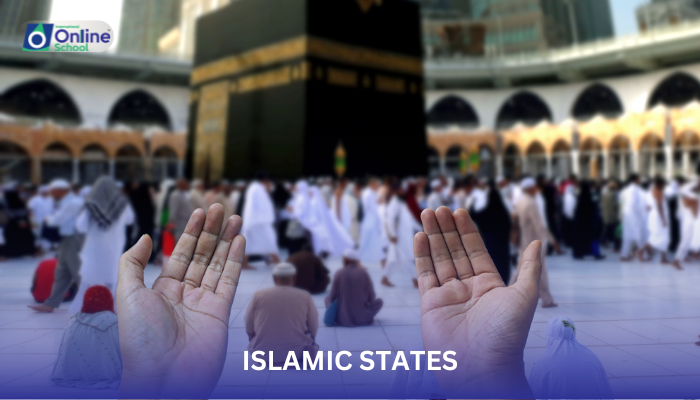
According to political science, the basic components of a state include territory, population, and enforcement. A state must have proper boundaries which are commonly called territory. Humans settle in this area, there must be a law for these humans and there must be a force to implement this law. It is called the government or the effective force. The power in the Islamic state is exclusively in the hands of Allah Almighty. All the institutions and plans of an Islamic state must be according to the commandments of Allah Almighty.
Muslim scholars have described three basic institutions of society which are called family, mosque and school. These three institutions play an important role in the training of man. These trained people strengthen the state by offering their services in government institutions. The basic institutions of the state are called Legislature, Judiciary, Administration. Members of the legislature make laws. Provincial and National Assemblies and Upper House i.e. Senate are called legislative bodies. Judiciary makes decisions according to this law and administration implements these decisions. Media highlights the positive and negative characters in front of the public.
Islamic state is actually a welfare state. The purpose of the welfare state is to establish a society that is benevolent and serves the people through justice in every field, which in the light of the teachings of the Prophet (s), is responsible for the establishment of public law and order and defence arrangements. Besides, it should establish the system of brotherhood, love and trust in every sphere of life.
In the religion of Islam, religion and politics are closely related. The main objective of the political system of Islam is the creation of a nation that knows justice and fairness and this is possible only through the exaltation of divine orders in every field of life. Regarding the basic duties of a Muslim ruler,
Allah Almighty says:
Translation:
''Those who, when We give them power in the land, establish Salah, pay Zakat, bid what is Fair and forbid what is Unfair. And with Allah lies the fate of all matters.'' (Surah Al-Hajj: 41)
Among the other duties of Muslim officials are the establishment of justice and fairness, eradication of poverty, public welfare, promotion of Islamic teachings, enforcement of Islamic judicial orders, defence of the Muslims and support of the Islamic nation, and order to perform good and forbid evil in the society.
In an Islamic welfare, administration is based on the teachings of Quran and Sunnah in every aspect. Apart from the Quran and the Sunnah, no such law can be made in the field of law and justice that is against the teachings of Islam because the main aim of the state is to protect the rights and targets of the people so that they will get equal chances to prosper. In an Islamic state, there is no difference between Muslims and non-Muslims as human beings. The Islamic state protects the life, wealth and honour of non-Muslims and gives them a lot of rights. Islamic government allows the non-Muslims to freely follow their religion and protects their places of worship.
The Islamic army and officials had special instructions not to spread disturbance on land, not to go against the laws of Shariah, not to cut date trees nor burn them, not to kill animals, not to burn fruit bearing trees, not to demolish places of worship, not to kill children, old people and women. They will find many such people who have made themselves limited to the churches and they had no link with this world so leave them alone. (Muwatta Imam Malik: 966)
The best model of an Islamic state is the state of Madina. The Holy Prophet prepared a proper flag of Madina. Masjid-e-Nabwi was given the status of the central secretariat of the government and taught discipline to the Muslims by organising congregational prayers. Masjid-e-Nabwi was the main point for Majlis-e-Shura, supreme court and army preparations. As an economic institution,an atmosphere of mutual cooperation was developed in the form of Mawakhat-e-Madina. (Sun Bayhaqi: 11642)
In the judicial system, the intellectual companions, Hazrat Ali al-Murtaza , Hazrat Abdullah bin Masoud and Hazrat Muaqal bin Yasar were involved. At the provincial level, Hazrat Muadh bin Jabal () had the powers of a Qazi. Educational institutions like Sufah and Dar-e-Arqam were established in the educational system. Providing the foundation of local government system, the Holy Prophet (s) appointed a woman named Umm Mihjan in the mosque for cleaning. A slave of Tamim Dari was appointed to light lamps in the streets at night and a census of Muslims in Madinah was carried out.
It is the duty of all the people living in the Islamic state to use all their abilities honestly in the construction and development of the state. Prioritize the collective and state interest over their personal interests. In order to achieve these objectives, it is necessary that the state institutions perform their basic duties and establish the best system of education and learning in order to create a favourable environment for the best Muslims in the society as well as citizens who are skilled in knowledge and art.
